Saturday, 25 February 2023

Women Bus conductors First World War

 Women were called upon to sustain the war effort at home. The LGOC went on to employ over 3,500 women from 1916 as bus conductors sometimes referred to as ‘conductorettes’.


Recruitment Poster for female bus conductors 1916


Florence Cordell photographed in 1916 as an LGOC Bus Conductor


Florence Cordell photographed showing her waybill to the inspector. A waybill is a list showing passengers or goods being transported on a vehicle.


The women had to undergo a medical and take an arithmetic test to ensure they could calculate the fares and give the correct change. If successful, the applicants proceeded to a two-week training course. Training concluded with an oral and written examination.


Florence Cordell was a Londoner, who’d left school at the age of fourteen to work in a lampshade factory. With the war leading to

a down-turn in trade and work prospects, Florence began to look for war work instead.

Aged 21, Florence applied to work on the Underground, but Florence was turned down for not being tall enough Instead she applied to be bus conductor with the London General Omnibus Company and was readily accepted.

To start with, Florence worked as a spare. It was essential that the

buses left the depot on time and if someone didn’t turn up, a spare

had to be ready to take their place. 


She quickly had to learn how to run her thumb over the surface of the coin before accepting it for bus fares especially during the blackouts where there would be no light on top of the open bus. This is when people tried to pay a less amount or pretend to pay more so they could receive their change back. 


If when you banked your money at the end of each shift and it was less then what it should be. The ‘unders and overs’ list as it was referred to would be checked the next day. Then the difference would be taken out of your wages.


Once Florence was assigned a route, she received a regular income and was paid the same as the male conductors. It was only later on, when the bus company proposed paying the women five shillings a week less for the same work as the men, that the transport workers, both male and female, went on strike in 1918.


 Being a bus conductor gave Florence financial independence and a sense of pride, but it came to an end in 1919. She had married during the war and reverted to the pre-war life that a married woman did not work unless her husband was very poorly paid and she really had to.

Friday, 24 February 2023

Islington Strongman ‘Mad Tom’

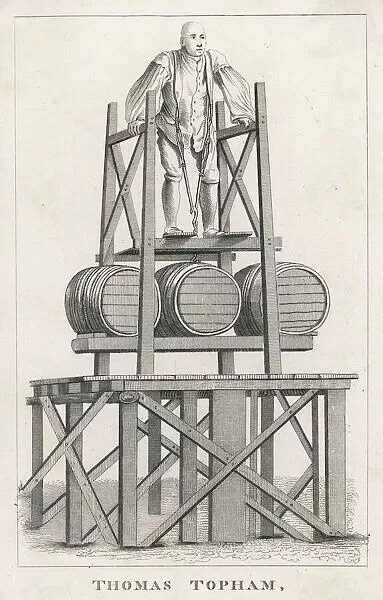
 Thomas Topham was born in 1710 a son of a carpenter.

In his early life he was a landlord of the Red Lion Inn near old 

St. Luke’s hospital.

Later a landlord at the Dukes Head Public House in Cadd’s row later called St. Albans Place near Islington Green.


But let me take you to the 28th May 1741 when Thomas showed a patriotic gesture to the Admiral Vernon for his capture of Porto Bello.

This spectacle was witnessed by thousands of people and took place opposite Cold Bath Fields at the Apple Tree Inn.

Thomas is shown in an illustration about to lift three hogsheads of water weighing 1336 pounds several inches from the ground.


Thomas performed regularly for the Royal Society where Dr. Desaguliers a British philosopher originally he was an experimental assistant to Issac Newton. He hired Thomas to become a personal bodyguard for the Royal Society and promised to make him even more famous.


In 1749 after finding out about his wife’s infidelity he stabbed her several times. Then injured himself and died from his wounds a few days later at the Bell and Dragon Inn where he was Master at Hogs lane Shoreditch.


Thomas is buried in St. Leonard’s church Shoreditch. 


Saturday, 15 October 2022

Jewish War Hero

 Jewish War Hero 


Photo of Barnett Lewis 1941


September 23, 1940, German bombs smashed into a residential pub in Manor Park, Newham, a few blocks from where Lewis was stationed.  Beneath the pub was a bomb shelter with 60 people trapped inside. The building burning, collapsing. A water main burst. The basement shelter was flooding, threatening to drown any survivors.


Lewis and a colleague ran to the site.


The London Gazette reported the story.


“A large HE bomb fell on three shops under which were two public shelters containing over 60 persons. The roof of the shelter collapsed. The bomb also caused a water main to burst which flood them to a depth of approximately two and a half feet before it could be turned off. Those who were not injured were quickly got out, but one man was trapped and in danger of being drowned, while four other men were pinned by the legs.


Lewis waded through the water to the first man and finding that he was wedged in with large pieces of brickwork and timber; (he) jacked up the dangerous roof and by sheer strength forced the brickwork away. he then found that the timber was still holding the man down. He crawled back and obtained a saw with which he cut this away, thus freeing the man just as the water reached his head. Lewis no doubt saved his life.”


Lewis, though at great and continuing risk to his own life, returned numerous times to the burning building as it was collapsing about him to save multiple people. 32 people had been killed.  28 would be saved.


Lewis was commended for the George Medal, the G.M. It is second only to the George Cross, equivalent to the American Congressional Medal of Honor.


To his surprise, for doing what he only felt was his duty, Lewis was presented to the King of England at Buckingham Palace. The King personally pinned the George Medal to him.


Lewis joined the regular army and was posted as an arms instructor attached to the Royal Fusiliers and Middlesex Regiments at the Machine Gun Training Centre. Ever modest, he would not wear his GM ribbon. He was ordered to do so by his Commanding Officer as an example to the younger men he was training.


Mr Lewis passed away in Bournemouth in 1998. His family described him as a kind man and someone who was practical and always willing to help others. They also said that he never spoke about his medal except when he wore it to the AJEX military parade every year.


The Plaque was unveiled on Saturday 9th July 2022 and reads:


At 9 Brooke Road, lived Air Raid Warden

Barnett Lewis

GM (George Medal)

Jewish War Hero

September 23, 1940, at extreme personal risk,

He saved many civilians during the Blitz.

(Hebrew)

Be strong and of good courage (Joshua 1:9)

Jewish American Society

For Historic Preservation and AJEX


The Lewis historical marker project is the tenth in a series of Jewish British historical markers that have been created. 


(Address now known as Cottage walk No.9 Brooke road was demolished)

#stokenewington