Thursday, 5 March 2020

Wiltons Music Hall

Wiltons Music Hall is truly a hidden gem in the east end located in Graces Alley Whitechapel London and it is well worth a visit. You can take a tour with a guide around the  building which is packed with useful interesting information about the music hall and surrounding area and lasts approximately for one hour.
Whilst waiting before the tour begins I would recommend visiting the history room which is very insightful, but doesn’t give any spoilers.
I’m going to give some insight of the history of Wiltons music hall now.

Originally an alehouse dating from 1743 or earlier, 

Wilton's is a unique building comprising a mid-19th Century grand music hall attached to an 18th-century terrace of three houses and a pub.

1826, it was also known as The Mahogany Bar, reputedly because the landlord was the first to install a mahogany bar and fittings in his pub. In 1839 a concert room was built behind the pub and in 1843 it was licensed for a short time as The Albion Saloon, a saloon theatre, legally permitted to put on full-length plays. John Wilton bought the business in c. 1850, enlarged the concert room three years later, and replaced it with his 'Magnificent New Music Hall' in 1859.
Wiltons was built on the same site as the former concert room of the Albion Saloon. Wilton furnished the hall with mirrors, chandeliers and decorative paintwork, and installed the finest heating, lighting and ventilation systems of the day. In the theatre, a single gallery, on three sides and supported by 'barley sugar' cast iron pillars, rises above a large rectangular hall and a high stage with an arch. In its heyday, a 'sun-burner' chandelier of 300 gas jets and 27,000 cut crystals, illuminated a mirrored hall.

In the thirty years Wilton's was a music hall, many of the best-remembered acts of early popular entertainment performed here, from George Ware who wrote 'The Boy I love is up in the Gallery', to Arthur Lloyd and George Leybourne known as Champagne Charlie.

Wiltons was destroyed by fire in 1877 however it was during the 1870s that the music hall had several ownerships and an eight year rebuild was but in place the building was bought by the Methodist Church East End Mission.

During the Great Dock strike of 1889, a soup kitchen was set up at The Mahogany Bar, feeding a thousand meals a day to the dockers families. The Mission remained open for nearly 70 years, through some of the most testing periods in East End history including the 1936 Mosley March and during the London Blitz of World War II.

During the 1950s the church ceased and the hall was used for rag storage as a warehouse. During the 1960s the London county council put in for compulsory purchase for slum clearance whereby Wiltons was scheduled for demolition.

However a campaign was started to save Wiltons and all its glorious history and in 1971 was awarded with grade II listed status and today is now recognised as not only a music hall but a heritage site. 


Frances Mayhew, former Managing and Artistic Director took over the building in 2004, It was again derelict from the late 1990’s and in debt. In June 2007 the World Monuments  Fund added the building to its list of the world's "100 most endangered sites".

Over the next decade Frances Mayhew and her team restored the building with a programme of arts and community activities and the reinstatement of The Mahogany Bar. The profile grew and in 2012, thanks to donations.

Enough money was raised to carry out the first half of a Capital Project to repair the building. 
This first half repaired the auditorium and in 2013, with support of Heritage Lottery Fund and other donors, Wilton’s was able to raise the £2.6 million needed to begin part two of the project to repair the houses, numbers 1 to 4 Graces Alley and 17 Wellclose Square, which make up Wilton’s front of house. This included creating a new Learning and Participation Studio funded by the Aldgate and Allhallows Foundation. The project was completed in September 2015 leaving the building structurally secure – probably for the first time since the renovations of music hall days.

It’s thanks to these campaigns and restorations that a piece of London Music hall history is ours still to treasure today.

 Exterior of Wiltons Music Hall

 Mahogany Bar


Wilton Staircase

 Inside Wiltons

Foundation stone 


John Wilton 


Wiltons Music Hall


Wiltons Music Hall


Wednesday, 26 February 2020

Pollocks Toy Shop Hoxton


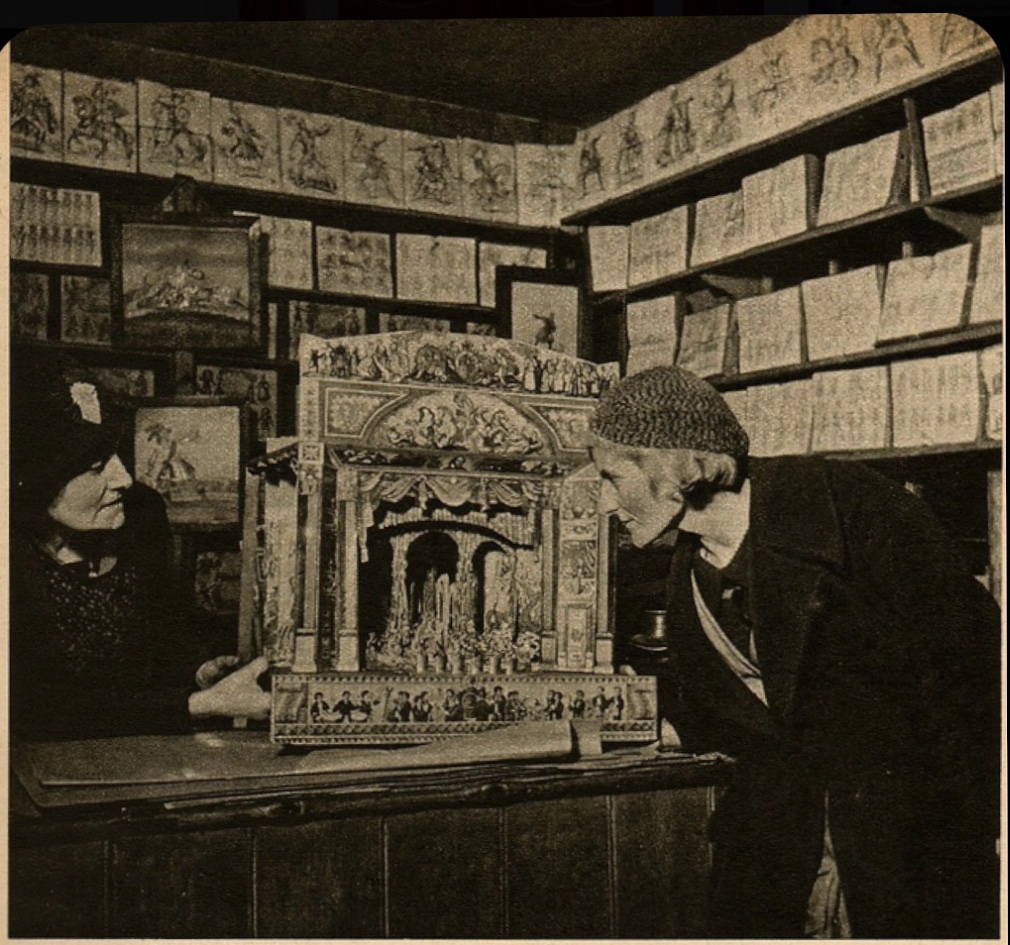
Many of you may have heard of Pollocks museum and toy shop which is based In Fitzrovia London but I was doing some research the other day around Hoxton and looking into old photos of Hoxton Street Market. When I came across an old photo of Pollocks toy shop and printers so I dug a little deeper and realised that this is where it all started dating back to a man by the name of John Redington who was born in 1819 described himself as a "Printer, Bookbinder and Stationer; Tobacconist; and Dealer in miscellaneous articles", opened a theatrical print warehouse at 73 Hoxton Street in 1851.

 Redington was an agent for the toy theatre publisher John Kilby Green, and when Green died in 1860 Redington bought up his engraved copper plates. Redington ran the Hoxton Street business until his death in 1876, following which his widow, youngest son William, and daughter Eliza carried on with the business; but soon only Eliza Redington was left to run the print business.

Until she married Benjamin Pollock where they ran the shop together. The business that Benjamin Pollock had inherited consisted of the toy theatre sheets of both J. K. Green and J. Redington. The material subsequently sold by Pollock was therefore predominantly from these previous publishers, with the imprint changed to 'B. Pollock until Benjamin’s death in 1937 he hand printed, constructed and coloured much of the toy theatre material which you can now visit in the museum today.

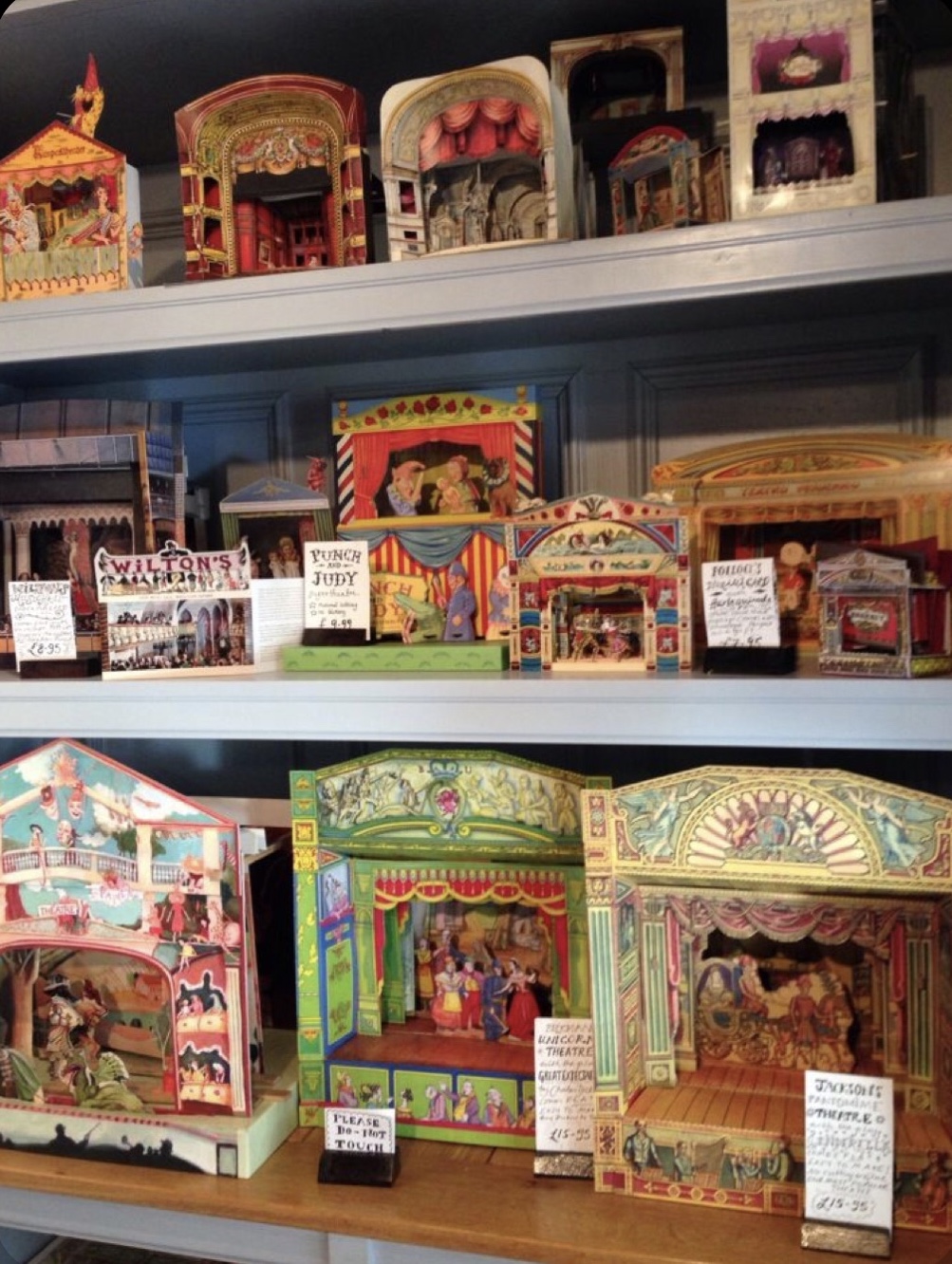
Today the shop produces its own range of toy theatres by contemporary artists such as Kate Baylay and Clive Hicks-Jenkins which have been displayed at Liberty, Fortnum & Mason and the Royal Opera House. It sells reproduction and original toy theatres from around the world in addition to books, puppets, music boxes and other traditional toys.

During the 1880s Benjamin Pollock's Toy Shop, as it was now known, was still opposite the Britannia Theatre at 73 Hoxton Street in Hoxton. The shop was unfortunately subj.ect to bomb damage during the Second World War.
Today a plaque marks the shop's original location on Hoxton Street.

Photo 1: Redington’s shop on Hoxton street as depicted on a ‘twopence coloured’
Photo 2: Benjamin Pollock outside his shop in Hoxton Street
Photo 3: Possibly Eliza Benjamin’s wife outside the shop
Photo 4: Children peering into the shop window in Hoxton street
Photo 5: Taken in 1937 inside Pollocks Toy shop
Photo 6:  Pollocks Museum and Toy shop today in Fitzrovia
Photo 7:  Victorian theatres inside the shop today


Friday, 7 February 2020

The Handkerchief with a story....

When looking through my Great Nanny Ives things I came across a handkerchief that is hand embroidered with the emblem of The Royal Fusiliers with a blood stain, I wondered who this must have belonged to.
I went onto do some further research it appears that the handkerchief belonged to my 2 x Great Uncle Charles Edward Ernest Graham, my great Nan’s brother.
Charles was born on 20 September 1899 and grew up in 88 Ironmonger Row St Lukes Finsbury, now part of the London Borough of Islington today. When Charles signed up at the age of 18 years for service he’s occupation was a Carman he fought in WW1 with The Royal Fusiliers in 3rd London Regiment and 10th London Regiment as Private Charles E E Graham.
On the 1st September 1918 he received a gunshot wound to his left hand in France Charles fought in the Battle of the Somme and was injured in Pont-Remy he was sent to The Holborn Military Hospital in Mitcham after the wound healed he was sent for a medical, he was left with impairment he could no longer grip using the left hand he was discharged and sent to the reserve. This gun shot wound most probably saved his life in the long run, whilst researching I came across various photos of men in Charles regiment and it made me wonder who got the chance to come home to see their families and who didn’t make it.
The Royal Fusiliers War memorial, a monument dedicated to the almost 22,000 Royal Fusiliers who died during the First World War, stands on Holborn in the City of London.

In 1921 Charles was awarded the Victory Medal and British War Medal
Charles later married his wife Ivy in 1927 in Shoreditch they resided in Forston Street Shoreditch then moved back to Islington (Packington Street) in 1934 and in 1939 his occupation was a lead and tin metal caster.
Charles wife Ivy passed away in 1969 and Charles later passed away at the age of 75 in 1975 and was laid to rest with his wife in Newham.
Sources 
Photo 1, 2 & 3 Handkerchief
Photo 4, 5 & 6 Soldiers from The Royal Fusiliers 
Photo 7 Royal Fusiliers Badge
Photo 8 Royal Fusiliers Memorial in Holborn

God Bless Uncle Charles